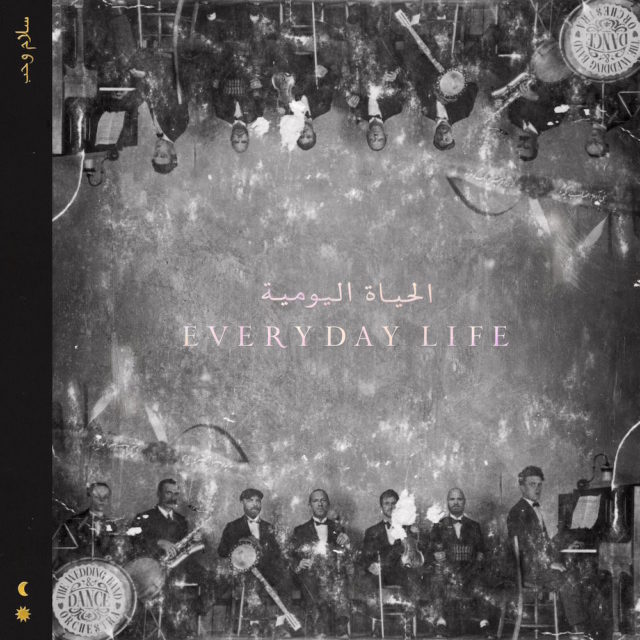
Oh look, a new Coldplay album. Because they’re still a thing for some reason. Now don’t get me wrong, I love Coldplay. Throughout the 2000s they consistently released some of the greatest pop rock music of my lifetime, and albums such as Viva La Vida or Death and All His Friends and A Rush of Blood to the Head still hold up incredibly well today. However, the entirety of their output from the 2010s has been, to use technical music critic language, really really boring. I won’t say I hate any of it, mainly because in order to hate it, I would first have to care. More than anything, it’s just bland, safe, vanilla pop rock, that almost rivals Maroon 5 and Imagine Dragons in its lack of ambition or imagination. Long story short, you could say I didn’t exactly dive into this new album with very much hope.
And I certainly didn’t feel very reassured to discover that this album consists of two disks, Sunrise and Sunset. Fortunately, my next discovery was that the entire album clocks in at only 53 minutes, with each disk being under half an hour long. Hardly worth putting on two separate disks in my opinion, but hey, I was just glad I didn’t have to listen to an hour and a half of 2010s Coldplay. So did listening to this album convince me that the two-disc format was necessary, or even justifiable?
Well, no. I can honestly say that nothing is gained from this album being divided into two discs (except maybe a little bit of inconvenience for those listening on hard copy). And I guess I can’t really take points off for this, but it was just an unnecessary formatting choice. Judging by the decision to name each of the disks, and the amount of brief interludes and instrumentals that are included, it seems that Coldplay’s ambition for this record was to create an epic, two-disc magnum opus, in the vein of Mellon Collie or Stadium Arcadium. But again, with a run time that doesn’t even hit the one-hour mark, this really isn’t possible. The main issue here is the shorter songs and interludes. Many of these feel like unfinished ideas that could use more work. On top of that, every one of them either features a stripped back, finger-picked acoustic guitar approach, a lush combination of piano and strings, or a gospel choir. On their own, any one of these short tunes actually sound pretty good, but recycling through these three textures for the duration of this album gets pretty stale, especially when there are as many of these pieces as there are full length songs (which is another issue of its own).
The strange layout of this project aside, I will say that much of the music actually pleasantly surprised me. When you trim the fat and focus on the full-length songs, most of them are pretty solid. “Trouble in Town” is a powerful statement on race relations and police brutality, featuring a haunting instrumental section and vocal melody, as well as an audio recording of a real instance of abuse of power. Not a comfortable song to listen to by any means, but then again, maybe that means the band got their message across. “Daddy” is a beautiful and heartbreaking song, sung from the perspective of a son, who longs to have a relationship with his negligent father. As implied by the title, “Old Friends” is an endearing message to an old friend, reveling sentimentally in the good old days. The only seriously weak lyrical moment is “Guns,” a song that begins by lamenting gun violence in America, but by verse two, devolves into a word salad of generic talking points a bout a myriad of unrelated topics.
While this album is easily more spirited and ambitious than anything else Coldplay have released in the last decade, that doesn’t necessarily make it all that interesting. Musically, this album is pretty sleepy, top to bottom. I know Coldplay is known for making music that is relatively slow and soft, but at least classic tracks such as “Clocks” and “Viva la Vida” manage to be very epic and dynamically interesting in their instrumentation. And on this album, while the shorter interlude tracks follow the same few stylistic patterns I mentioned, the full length songs are all very soft and atmospheric. One noticeable change from the band’s most recent material is that the electric guitar is extremely prevalent on these songs. However, the lead lines don’t seem “written,” so much as improvised and crammed into the final mix. And while this tends to work for bluesy hard rock music, it feels somewhat out of place on a Coldplay album.
There are only two major musical deviations on this album. The first one, “Arabesque,” is a swinging, New Orleans style jazz tune, featuring a horn section and a saxophone solo. This is perhaps the strongest musical moment on the album. The other, “Cry Cry Cry” is a 60s doo wop inspired track, featuring artificial record hiss for maximum cheese. This track overall is okay at best, and is more or less ruined by a strange, high-pitched voice, accompanying the voice of lead singer Chris Martin. We also have the lead single, “Orphans.” Without a doubt the weakest moment on the album, “Orphans” is more or less a lame pop song in the style of this band’s last several singles from recent albums. You could easily replace this song with “Sky Full of Stars” or “Adventure of a Lifetime,” and nobody would even notice. The last two songs, “Champion of the World” and “Everyday Life” are the closest we get to classic Coldplay. Nowhere near as good, but a welcome return to form and satisfying end to the album, nonetheless.
Everyday Life is without a doubt the best Coldplay album since Viva la Vida or Death and All His Friends. The use of horns, choirs, and strings, while a little bit repetitive, still makes for a much more interesting sonic palette than anything we’ve heard on their last three albums. And many of the songs are really good…some of the best they’ve written in a very long time. However, this isn’t enough to save Everyday Life from being a jumbled and confusing album. In order to make this album more coherent, the band needed to either trim it down to a regular length, single disc LP, or fully committed to the two-disc epic idea, and finished some of the songs that clocked in at roughly a minute and a half (though they would’ve had to make some of these songs MUCH more sonically and dynamically diverse for that not to be a miserably boring experience). So depending on which way you look at it, this album is either overly bloated, or incomplete. Either way, what we’re left with is a solid rough draft in need of thorough revision.
Score: 5/10
Favorite Song(s): Trouble in Town, Daddy, Arabesque
Least Favorite Song(s): Orphans, Guns, Cry Cry Cry
 Phil Klinker Music Reviews